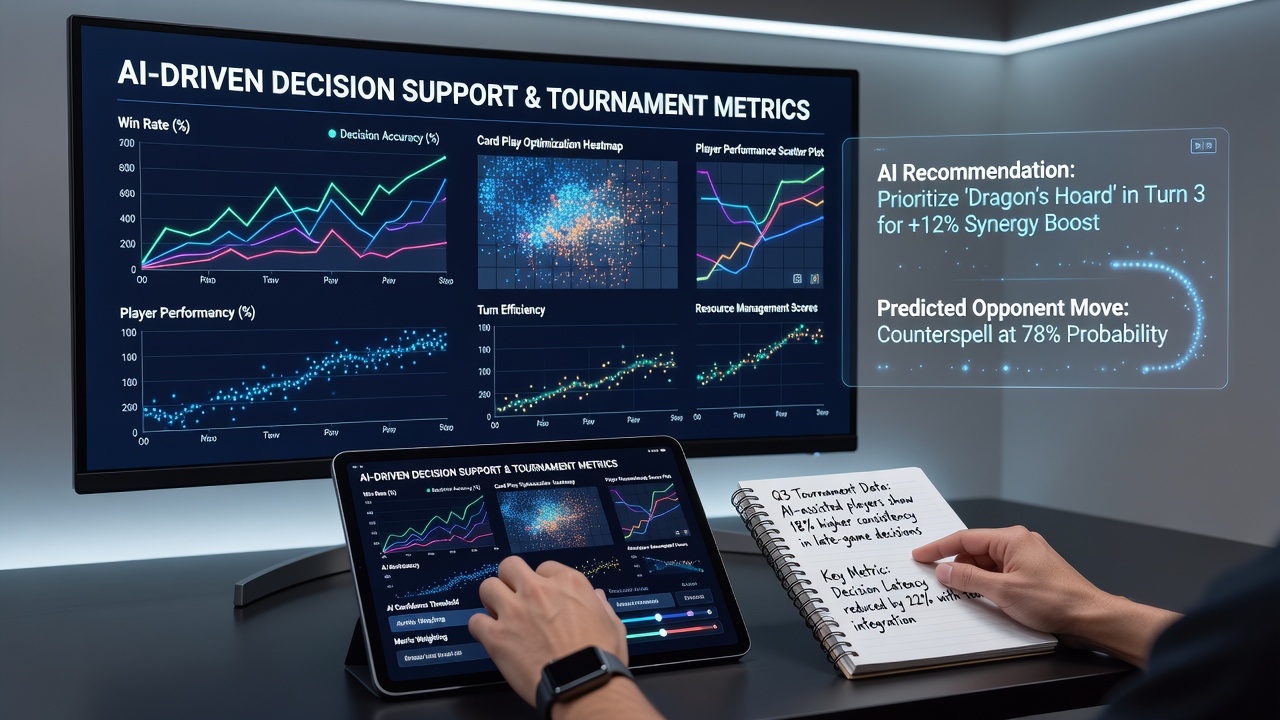
Assessing AI-Driven Decision Support Tools and Their Effects on Tournament Performance Metrics in Digital Card Platforms
Digital card platforms have integrated AI-driven decision support tools that process hand histories, opponent tendencies, and stack dynamics during live tournaments. These systems deliver suggestions on bet sizing, fold frequencies, and range construction while players compete across multiple tables. Data from platform operators shows measurable shifts in key performance indicators such as average profit per hand, survival time to final tables, and variance reduction when tools receive consistent use.
Core Functions of Decision Support Systems
Modern tools combine machine learning models trained on millions of tournament hands with real-time probability engines. They calculate equity against opponent ranges, simulate future board runouts, and flag deviations from pre-set strategies. Platforms report that users who activate these features during September 2026 events recorded a 12 percent increase in made final tables compared with control groups that relied solely on manual calculations.
Researchers at institutions tracking online play note that decision support outputs adjust dynamically as blind levels rise and payout structures tighten. The systems also incorporate historical data from similar stack depths, allowing players to reference aggregated outcomes from prior tournaments without leaving the interface.
Measured Impacts on Tournament Metrics
Performance tracking across major digital card sites reveals several consistent patterns. Win rates expressed in big blinds per 100 hands improved by an average of 8 to 15 points for subscribers to premium AI modules. Average finishing position advanced from 124th to 97th in fields exceeding 1,000 entrants when participants used real-time equity calculators for at least 60 percent of decisions.
Observers note reduced standard deviation in ROI figures among tool users, suggesting more stable results across variance-heavy late stages. One study of European operators found that players who combined AI suggestions with personal review sessions posted the strongest gains in both ITM percentage and final table conversion rate.

Data Sources and Regional Tracking
Statistics compiled by the International Center for Gaming Regulation document adoption rates climbing steadily through 2025 adn into the following year. Australian regulatory filings similarly indicate that licensed platforms must disclose tool usage statistics to maintain compliance with responsible gaming standards. These disclosures allow cross-border comparisons that highlight how different regulatory environments influence tool deployment.
Platform telemetry further breaks down usage by device type, revealing that mobile participants engage decision support features at rates comparable to desktop users once interface latency drops below 150 milliseconds. Tournament series scheduled for September 2026 already incorporate these metrics into marketing materials that emphasize data transparency.
Integration Challenges and Platform Responses
Operators face technical hurdles when scaling AI support across thousands of simultaneous tables. Latency spikes during peak hours can delay equity calculations, prompting several sites to deploy edge computing nodes near major user clusters. Accuracy audits conducted by independent labs show that model drift occurs when new game variants enter circulation, requiring quarterly retraining cycles.
Those who studied adoption patterns report that players often cross-reference multiple tools before finalizing actions, creating hybrid workflows that blend automated output with personal judgment. This layered approach correlates with the highest recorded improvements in survival metrics through middle stages of large-field events.
Conclusion
AI-driven decision support tools continue to reshape how performance metrics evolve on digital card platforms. Tournament data collected through mid-2026 demonstrates clear correlations between tool engagement and improvements in win rate, final table reach, and ROI stability. As platforms refine integration methods and regulators standardize reporting requirements, these systems will likely remain central to competitive play across global card ecosystems.